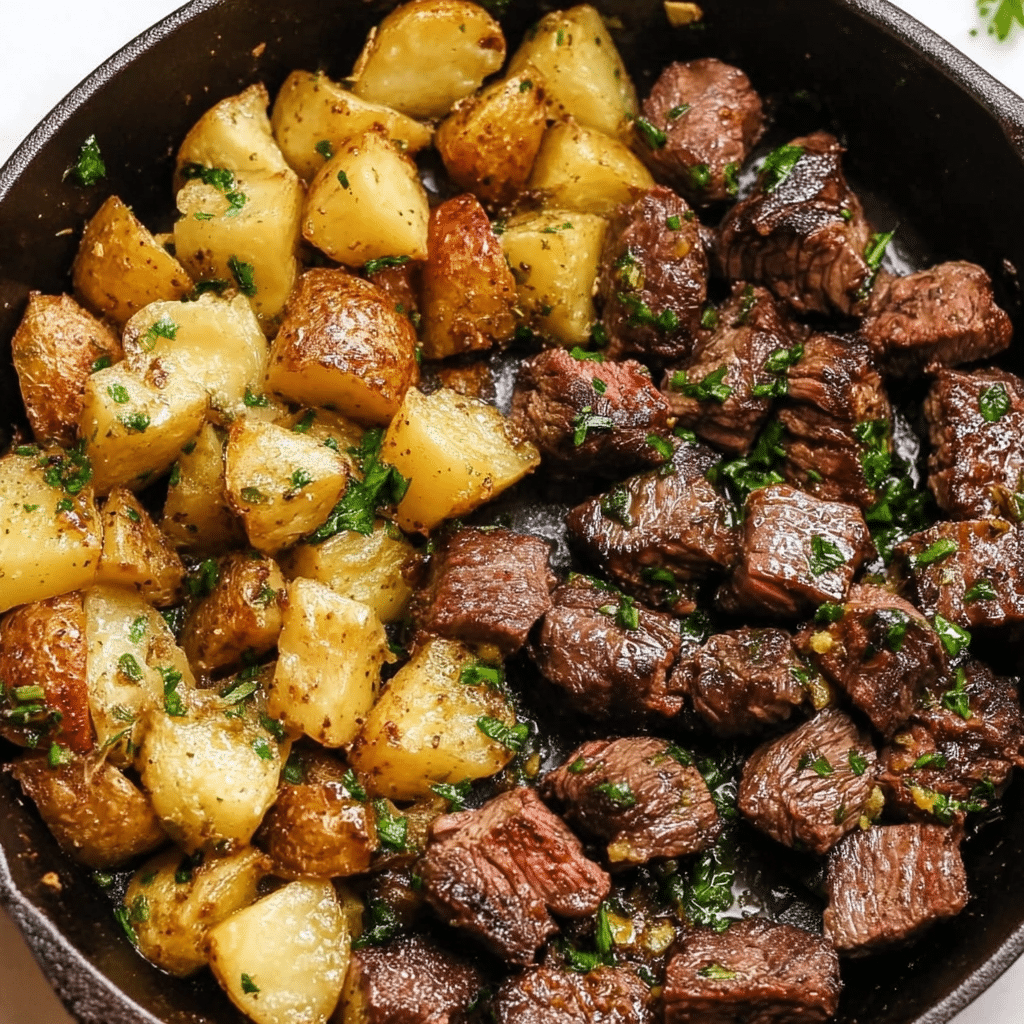
There exists a quiet, golden-hour tier of cooking that sits just above “survival scrambled eggs” but below “three-day brisket vigil.” It is the realm of the one-pan skillet meal—a genre often dismissed as merely convenient, but which, in its finest expression, becomes something close to alchemy. And at the heart of that genre, glistening with fat and fragrant with alliums, sits a dish so deceptively simple, so primal in its appeal, that it has no right to be as satisfying as it is. Ladies and gentlemen, I give you: Garlic Butter Steak Bites and Potatoes.
Let’s dispense with pretense immediately. This is not a recipe for a dinner party where you intend to impress a food critic or a first date who quotes The French Laundry cookbook. This is a recipe for a Tuesday. For the night when your soul is tired, your inbox is a war crime, and your stomach demands not just calories, but vindication. This is a dish that understands you. It asks for one pan, a handful of ingredients, and about twenty minutes of your fractured attention. In return, it delivers crispy-edged potatoes, seared beef that squeaks with tenderness, and a river of garlic-thyme butter that could make shoe leather taste like a hug.
But let’s not be fooled by its humble posture. Within this simple formula lies a masterclass in texture, heat management, and the sacred bond between fat and starch. So pull your cast iron skillet from its hiding place. We’re going deep.
The Philosophy of the One-Pan (Or, Why Your Mother Was Right About Cleanup)
Before a single cube of sirloin meets heat, we must acknowledge the vessel. The recipe calls for a cast iron skillet, and this is not negotiable if you want the truth. Could you use a non-stick? You could, in the same way you could drink champagne from a plastic cup. The experience will be technically functional, but devoid of soul. Cast iron’s superpower is thermal mass—it holds heat like a grudge, then distributes it with the evenhandedness of a benevolent dictator. When you drop those potato cubes onto a properly preheated cast iron surface, they don’t steam. They sear. That brown crust, that crackling edge, that thing that makes you close your eyes when you eat? That’s the Maillard reaction having a party, and cast iron is the only venue with a good enough sound system.
The recipe wisely begins with medium heat, olive oil, and two tablespoons of ghee. Note the choice of ghee over standard butter. Ghee, with its milk solids removed, boasts a higher smoke point, meaning it won’t turn into a bitter, acrid mess when you’re waiting for those potatoes to go golden. It’s clarified butter’s tougher, more reliable cousin. The olive oil joins not for flavor dominance—it would lose that fight immediately—but to raise the smoke point further and add a fruity bass note beneath the ghee’s nutty treble.
The Potato Gambit: Patience, Cubes, and the Art of Not Stirring
Here is where most home cooks commit the cardinal sin of skillet cookery: they fuss. You add the potatoes—those lovely, buttery Yukon Golds, cut into half-inch cubes like tiny edible dice—along with the minced garlic, thyme, oregano, salt, and pepper. And then the recipe delivers its first piece of hard-won wisdom: Cook for 2–3 minutes before stirring.
Those one hundred eighty seconds are an eternity in the mind of an anxious cook. Your hand will twitch toward the spatula. You will think, “They’re burning!” They are not burning. They are browning. There is a difference. Browning is flavor. Burning is regret. By leaving the potatoes undisturbed, you allow the side in contact with the pan to form that crisp, crackling crust that will later stand up to the buttery onslaught of the steak. Stir too early, and you’ll have a pile of steamed potato cubes that taste like regret and sadness.
After that initial sear, you stir frequently for the next eight to ten minutes. The garlic needs to soften without scorching—scorched garlic is the villain of many a would-be great dish, bitter and acrid and impossible to hide. The thyme and oregano, dried though they are, will bloom in the hot fat, releasing their Mediterranean perfume. And those potatoes? They’ll go from pale and hard to golden and fork-tender, their interiors fluffy as pillows, their exteriors a lattice of buttery crispness.
When they’re done, you remove them from the pan. This feels wrong, doesn’t it? It’s a one-pan dish, and you’re taking things out. Trust the process. The potatoes have done their duty. Now they must rest while the steak takes its turn in the arena.
The Sirloin Question: Why This Cut Deserves Your Respect
Let’s talk about the 1 ¼ pounds of sirloin steak, cut into half-inch cubes. Sirloin is not the sexiest cut. It lacks the marbleized poetry of ribeye, the buttery collapse of filet mignon, the cult following of brisket. What sirloin has, instead, is integrity. It’s lean but not punishingly so. It has beefy flavor without needing a week-long marinade. And when cut into small, half-inch cubes and seared hard, it performs a magic trick: it stays tender.
The key is in the recipe’s instruction to increase the heat to medium-high before adding the remaining two tablespoons of ghee. You want that pan screaming hot. You want to see the ghee shimmer and just begin to whisper smoke. Then, in go the steak cubes in a single layer. And here is the second test of your patience: sear for at least 2 minutes before stirring.
Again, do not touch. Do not poke. Do not jiggle the pan to see if they’re moving. Let the beef sit against that hot cast iron until a deep, mahogany-brown crust forms. The moment you stir too early, you release the meat’s grip on the pan, and you’ll steam rather than sear. Steamed beef cubes are gray, sad little things that taste of missed opportunities. Seared beef cubes are joy.
After those two minutes, you’ll stir and cook for another minute or two, just until the cubes are browned on all sides. The interior should still be pink—medium-rare to medium. Remember: these are small cubes. They cook fast. Overcooking turns sirloin into shoe leather faster than you can say “where’s the A1?”
The Reunification: When Potatoes and Steak Find Each Other Again
With the steak browned and the potatoes waiting offstage like a patient understudy, you return the spuds to the pan. This moment—the reunification—is the emotional climax of the recipe. The potatoes, which have cooled slightly, will absorb some of the residual beef fat and garlic butter. The steak, which has been resting in its own juices, will welcome the potatoes back like old friends. You toss everything together, adjust the salt and pepper—and here, taste as you go, for seasoning is not a suggestion but a conversation—and then you crown the whole thing with fresh parsley.
That parsley is not a garnish. It is a vital breath of green, a chlorophyll-driven brightness that cuts through the rich, buttery, beefy avalanche. Without it, the dish is delicious but monolithic. With it, each bite has a note of freshness, a whisper of the garden that reminds you that you are a person who eats vegetables, even if those vegetables are mostly a garnish.
The Science of Garlic Butter: A Love Story
Let us linger for a moment on the garlic butter itself, because this is where the dish transcends mere sustenance. Four tablespoons of ghee total (two early, two late), three cloves of garlic, and dried herbs. It’s a simple formula, but small choices matter. The garlic is added with the potatoes, not at the very end. This is intentional. Cooking the garlic gently in the fat for eight to ten minutes allows its allicin—that pungent, sulfurous compound responsible for raw garlic’s bite—to mellow into something sweet, nutty, and almost caramelized. Raw garlic is an exclamation point. Cooked garlic is a long, thoughtful sentence.
The dried thyme and oregano, often overlooked in favor of fresh herbs, are perfect here. Their low moisture content means they won’t steam the potatoes, and they’ll infuse the ghee with an earthy, slightly floral aroma that complements beef without overwhelming it. Fresh herbs would add brightness, yes, but they’d also add water. In a high-heat sear, water is the enemy.
When the remaining two tablespoons of ghee go into the pan for the steak, they pick up the fond—those browned bits left behind by the potatoes. That fond is pure flavor, a concentrated paste of potato starch, garlic residue, and herb oils. The ghee dissolves it, creating a sauce that coats each steak cube in a glossy, savory embrace.
Practical Wisdom for the Home Cook: Variations, Substitutions, and Grace
No recipe survives contact with the enemy—and the enemy is your actual kitchen, with its missing ingredients, finicky stove, and the child or pet demanding attention. So let’s talk adaptations.
Don’t have Yukon Gold potatoes? Red potatoes or baby creamers work beautifully. Avoid russets; their high starch content means they’ll fall apart into mush. No potatoes at all? Cubed sweet potatoes add sweetness and a vitamin-A boost, though they’ll need an extra minute or two to become fork-tender.
Don’t have sirloin? Flank steak, strip steak, or even trimmed chuck eye can substitute. Stay away from tough cuts like round or brisket—they need long, slow cooking to break down collagen, and this isn’t that recipe.
Don’t have ghee? Unsalted butter plus a teaspoon of oil will work, but watch the heat. Butter’s milk solids will brown (and potentially burn) faster. If you see black specks and smell acrid smoke, you’ve gone too far.
Want to add vegetables? A handful of green beans or asparagus spears can go into the pan during the last two minutes of potato cooking. Mushrooms are a natural partner—sliced cremini can join the steak for the final minute of searing.
Dietary swaps? For dairy-free, use coconut oil or avocado oil instead of ghee. The flavor will shift—coconut oil adds a tropical whisper that’s not unpleasant—but the technique holds.
And here is the most important piece of practical wisdom: do not crowd the pan. If you double this recipe, cook in batches. A crowded pan drops the temperature, and dropped temperature means steaming instead of searing. Steamed potatoes and gray beef are not the goal. You are better off spending an extra ten minutes than serving regret.
The Emotional Resonance of the One-Pan Meal
There is a reason this recipe has proliferated across TikTok, Instagram, and a thousand food blogs. It’s not just the taste, though the taste is undeniably excellent. It’s the feeling of competence it gives you. In a world that demands constant multitasking, where dinner often becomes an obstacle to be cleared rather than a pleasure to be savored, this dish offers a rare gift: a twenty-minute path to something genuinely delicious, made with your own hands, in one pan.
Look at what you’ve done. You’ve managed heat. You’ve exercised patience. You’ve transformed raw ingredients—a lump of beef, some dirty potatoes, a knob of fat, a few cloves of garlic—into a skillet full of golden-brown, herb-flecked, butter-glazed glory. You didn’t need a sous vide circulator or a blowtorch or a degree from Le Cordon Bleu. You needed a cast iron pan, a spatula, and the willingness to wait two minutes before stirring.
When you serve this, don’t bother plating individually. Bring the skillet to the table. Let everyone see the browned bits stuck to the sides, the parsley scattered like confetti, the last shimmering pool of garlic butter in the bottom. Let them scoop directly onto their plates, or, if you’re among trusted company, eat straight from the pan. This is not a dish for ceremony. It’s a dish for hunger—the real kind, the kind that wants salt and fat and heat and the deep, uncomplicated satisfaction of a meal that asks nothing more than to be enjoyed.
Troubleshooting the Common Tragedies
Even with the best intentions, things can go sideways. Let’s diagnose:
Problem: Potatoes are browned on the outside but raw in the center.
Solution: Your heat was too high. The outside burned before the inside could cook. Next time, lower to medium and extend the cooking time. You can also microwave the potato cubes for two minutes before the pan—a cheat, but an effective one.
Problem: Steak cubes are tough and chewy.
Solution: Two possibilities. Either you overcooked them (more than two to three minutes total after the initial sear) or you cut them with the grain instead of against it. Look at the raw steak: those lines running through the meat are muscle fibers. Cut perpendicular to them. Short fibers = tender bites.
Problem: Garlic is bitter and black.
Solution: Garlic burned. Add it later in the potato cooking process, or mince it more coarsely. Finely minced garlic burns faster than rough-chopped.
Problem: Nothing is browning; everything is steaming.
Solution: Pan wasn’t hot enough, or you overcrowded. Let the pan preheat for a full five minutes. Work in batches if needed. And dry your potatoes thoroughly before they hit the oil—water is the enemy of browning.
Serving Suggestions and Final Flourishes
This dish is a complete meal on its own, but if you want to gild the lily, a few accompaniments shine. A simple arugula salad with lemon vinaigrette cuts the richness. Crusty bread for sopping up the garlic butter is not optional—it’s mandatory. A glass of something bold and red, like a Malbec or a Côtes du Rhône, finds its natural partner here.
For a brunch twist, top the finished skillet with two or three fried eggs. The runny yolks mix with the garlic butter to create a sauce of indecent richness. For a spicy kick, a pinch of red pepper flakes with the garlic, or a drizzle of hot honey at the end.
And leftovers? If they exist—and they rarely do—reheat gently in a skillet, never a microwave. The microwave will turn your steak into rubber and your potatoes into sad, sweaty sponges. A quick re-sear over medium heat brings back the crisp.
Conclusion: The Skillet as Sanctuary
There is a reason humans have cooked in pans over fire for millennia. It’s not efficiency, though that’s part of it. It’s intimacy. The one-pan meal asks you to focus on just one thing at a time: first the potatoes, then the steak, then the reunion. It’s a meditation disguised as a recipe. In a world of endless notifications and fragmented attention, that might be its greatest gift.
So make this dish on a night when you need a small victory. Make it when the rain is hitting the window and the only light in the kitchen comes from the range hood. Make it for someone you love, or make it just for yourself, eating straight from the skillet with a fork, no plate, no pretense, no apologies. The garlic butter will run down your chin. The potatoes will crunch. The beef will give way like a promise kept. And you will remember, as you have always known, that the best meals are not the most complicated ones. They are the ones made with presence, with patience, and with the quiet understanding that sometimes, a little butter and a hot pan are all the magic you need.
PrintThe One-Pan Alchemy of Garlic Butter Steak Bites and Potatoes: Why Your Skillet Holds the Secret to Weeknight Glory
This garlic butter steak bites and potatoes recipe is a fast one-pan skillet dinner with crispy potatoes, juicy sirloin, and rich herb garlic butter.
- Prep Time: 10 minutes
- Cook Time: 20 minutes
- Total Time: 30 minutes
- Yield: 4 servings
- Category: Main Dish, Skillet
- Method: Stovetop
- Cuisine: American
Ingredients
- 1/4 cup ghee or butter, divided
- 1 tbsp olive oil
- 1 lb Yukon gold potatoes, cubed
- 3 garlic cloves, minced
- 1 tsp dried thyme
- 1/2 tsp dried oregano
- 1/2 tsp sea salt
- 1/4 tsp black pepper
- 1 1/4 lb sirloin steak, cubed
- Fresh parsley, chopped
Instructions
- Heat cast iron skillet over medium heat.
- Add olive oil and 2 tbsp ghee.
- Add potatoes with garlic, thyme, oregano, salt, and pepper.
- Cook 8–10 minutes until golden and fork tender.
- Remove potatoes and set aside.
- Increase heat to medium-high and add remaining ghee.
- Add steak cubes, season lightly, and sear 2 minutes before stirring.
- Cook another 1–2 minutes until browned.
- Return potatoes to skillet and toss together.
- Garnish with parsley and serve hot.
Notes
- Pat steak dry before cooking for best sear.
- Do not overcrowd the skillet.
- Use rosemary for a flavor variation.