
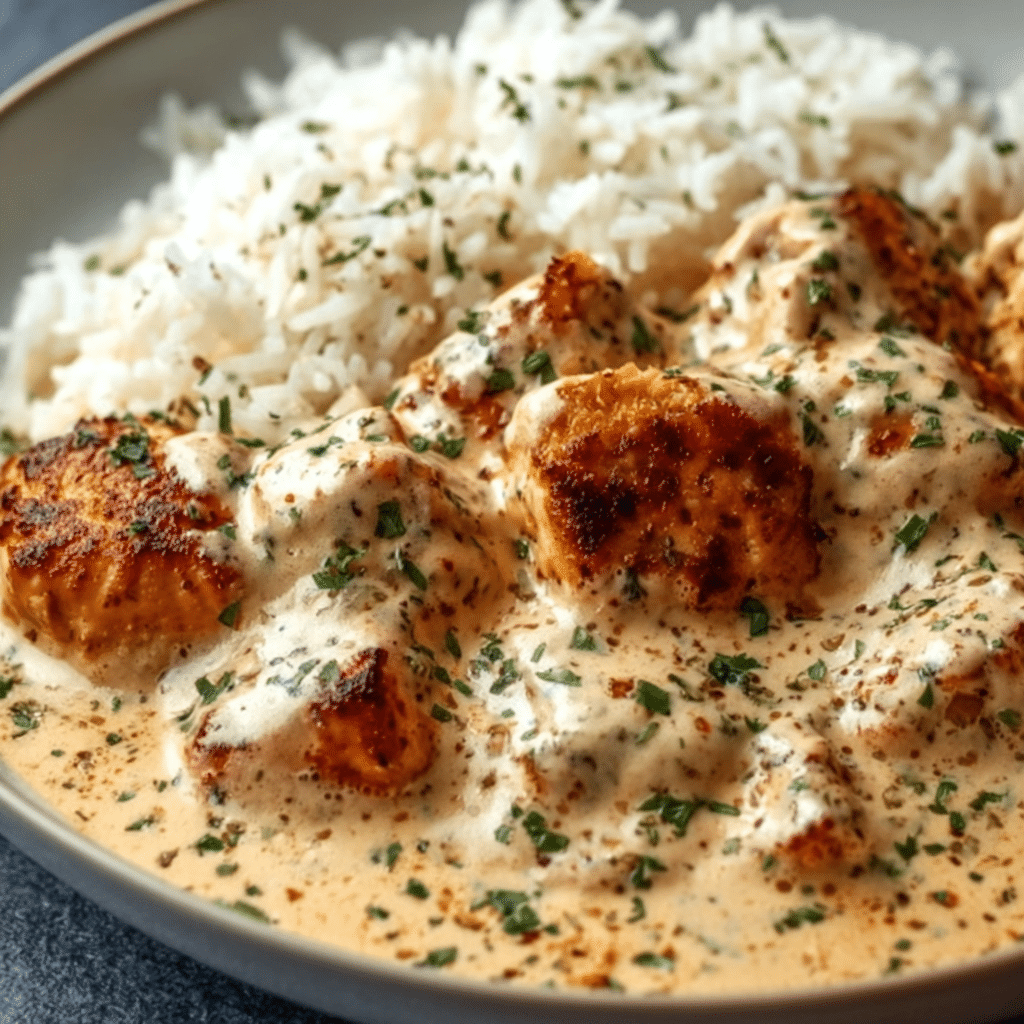
There is a specific kind of dinner that does not announce itself with fireworks or foam or tweezers-placed microgreens. It does not appear on the menus of restaurants where the lighting is intentionally dim and the portions are intentionally small. Instead, it lives in the collective memory of grandmothers, in the stained recipe cards of church cookbooks, and in the quiet, golden-hour cooking of people who understand that the best meals are not the most impressive—they are the most comforting. This meal, this Creamy Smothered Chicken and Rice, is the platonic ideal of that category. It is a dish that has never met a bad day it couldn’t improve, a skillet of such unapologetic, cheesy, creamy, poultry-based joy that eating it feels less like having dinner and more like receiving a warm embrace from someone who genuinely wants you to be okay.
Let us name the elements, because they deserve to be named with reverence. First, there is the chicken: four boneless, skinless breasts, seared until their exteriors wear a cloak of burnished bronze, while their interiors stay tender enough to yield to a fork. Then there is the rice: long-grain and fluffy, cooked not in water but in chicken broth, because water is for amateurs and regret. And finally—gloriously—there is the sauce. A creamy, cheddar-and-Parmesan-laced, thyme-kissed gravy that smothers everything in a velvety, decadent blanket. This is not a sauce that whispers. This is a sauce that pulls up a chair, puts its feet on the coffee table, and announces that it’s staying for dessert.
The recipe calls this dish “Creamy Smothered Chicken and Rice.” The word “smothered” is doing a lot of work here, and it is the perfect verb. To smother, in the culinary sense, is to cover entirely, to envelop, to love so thoroughly that nothing remains exposed. The chicken does not sit next to the sauce; it bathes in it. The rice does not merely accompany the chicken; it serves as a fluffy, absorbent stage upon which this dairy-rich drama unfolds. This is a dish for cold nights, for tired souls, for anyone who has ever thought, “I need dinner to feel like a hug.” And the best part? It comes together in a single skillet (plus one pot for the rice, but we’ll forgive that minor transgression), with ingredients you probably already have in your pantry. Let’s get into the gospel according to smothered chicken.
The Chicken: A Tale of Two Textures
The recipe begins, as all great chicken dishes should, with the seasoning. Garlic powder, onion powder, smoked paprika, salt, and pepper. This is not a complicated spice blend. There is no thirteen-ingredient masala or hard-to-find sumac. This is the all-American, blue-ribbon, never-fails combination that transforms a bland chicken breast into something you’d actually want to eat. The garlic and onion powders provide a savory base; the smoked paprika adds a whisper of campfire and a beautiful reddish hue; salt and pepper do what salt and pepper have always done—they wake everything up.
You pat the chicken breasts dry with a paper towel before seasoning. This step is not listed in the recipe, but it is implied by the laws of physics. Moisture is the enemy of browning. A wet chicken breast will steam, not sear, and steamed chicken skin is a tragedy. So dry those breasts like you mean it. Then coat them evenly with the spice mixture, pressing gently so the seasonings adhere.
Now, the sear. Two tablespoons of olive oil in a large skillet over medium-high heat. The oil should shimmer—almost but not quite smoking. Lay the chicken breasts in the skillet with the respect they deserve. Do not crowd them; if your skillet is small, cook in batches. The recipe says 4-5 minutes per side, and those minutes are a test of your self-control. Do not poke. Do not peek. Do not slide the chicken around to see if it’s browning. Let it sit. Let the Maillard reaction do its beautiful, caramelizing work. When the chicken releases easily from the pan—that’s how you know it’s ready to flip. If it sticks, it’s not done. Be patient.
After four to five minutes, the first side should be a deep, golden brown. Flip, and repeat. The interior will not be fully cooked yet—that’s fine. You’re not trying to finish the chicken here; you’re building a crust that will add flavor and texture, and you’re creating fond on the bottom of the pan. That fond—those browned bits left behind—is liquid gold in waiting. Do not wash it away. You will thank yourself later.
Remove the chicken and set it aside. It will rest, carryover-cooking slightly, while you attend to the rice and the sauce.
The Rice: Broth, Not Water, Because You’re Not a Savage
While the chicken rests, you turn your attention to the rice. And here is where many home cooks make a terrible, soul-crushing mistake: they cook rice in water. Water is fine for boiling pasta. Water is fine for tea. Water is not fine for rice that is meant to accompany a smothered chicken dish of this caliber. The recipe calls for two cups of chicken broth and half a teaspoon of salt, and this is not a suggestion—it’s a commandment.
Bring the broth to a boil in a medium saucepan. Add the long-grain white rice (one cup, measured with a steady hand), reduce the heat to low, cover, and simmer for 15-18 minutes. Do not lift the lid. Do not stir. Rice is a shy, sensitive grain, and it needs time alone to absorb liquid and become fluffy. Lifting the lid releases steam, which disrupts the cooking process. Trust the rice. Trust the timer.
When the time is up, remove the pan from the heat and let it sit, still covered, for five more minutes. Then fluff with a fork. What you’ll have is a pot of rice that is separate, tender, and infused with savory chicken flavor. It will be a bed worthy of the smothered chicken to come. Set it aside, and resist the urge to eat it by the spoonful. (Resistance is optional. I won’t tell.)
The Sauce: Butter, Flour, Milk, and the Alchemy of a Roux
Now we arrive at the heart of the dish, the moment when the skillet transforms from a mere cooking vessel into a cauldron of creamy, cheesy, herb-flecked magic. You’ll use the same skillet you used for the chicken. Do not clean it. Do not wipe it out. Those browned bits on the bottom—the fond—are about to become the foundation of your sauce.
Melt two tablespoons of unsalted butter over medium heat. Once it’s foamy, whisk in two tablespoons of all-purpose flour. This mixture—butter and flour cooked together—is called a roux, and it is one of the most important techniques in all of cooking. A roux thickens liquids without clumping, and it adds a nutty, toasty depth that you simply cannot get from cornstarch or other shortcuts.
Cook the roux for 1-2 minutes, whisking constantly, until it turns a pale, golden blonde. Do not walk away. Do not check your phone. Roux can go from blonde to brown to burnt in seconds, and burnt roux tastes like regret. You’re looking for the color of light sand, with a smell that’s vaguely nutty and deeply comforting.
Now, here comes the part that intimidates novice cooks: adding the liquid. The recipe calls for one and a half cups of whole milk and half a cup of chicken broth, added gradually while whisking constantly. This is not the time for a leisurely pour. You want to add the liquid in a slow, steady stream, whisking vigorously to prevent lumps. The roux will seize up at first, becoming a thick paste, and then loosen as more liquid is added. This is normal. Stay calm. Keep whisking.
Once all the liquid is incorporated, you’ll have a smooth, pale sauce that is still quite thin. This is correct. The sauce will thicken as it heats and as the starches in the roux activate. Bring it to a gentle simmer, still whisking occasionally, and watch as it transforms from thin milk to velvety gravy.
The Cheese: A Duet of Cheddar and Parmesan
With the sauce smooth and simmering, it’s time for the cheese. Half a cup of shredded cheddar cheese and half a cup of grated Parmesan cheese. Not pre-shredded if you can avoid it—pre-shredded cheese contains anti-caking agents that can make your sauce grainy. Shred the cheddar yourself from a block. Grate the Parmesan from a wedge. The extra sixty seconds of effort will reward you with a sauce that is silky, not sandy.
Add the cheeses gradually, a handful at a time, whisking until each addition is fully melted before adding the next. Cheddar brings sharpness, creaminess, and that unmistakable orange-gold color (if you use yellow cheddar; white cheddar works too, but the visual impact is slightly less dramatic). Parmesan brings nuttiness, saltiness, and a granular texture that helps the sauce cling to the chicken.
Stir in the garlic powder and thyme. The garlic powder reinforces the notes from the chicken seasoning, creating a through-line of flavor. The thyme adds an earthy, slightly floral note that prevents the sauce from becoming one-dimensional. Some recipes would stop here, but this recipe understands that thyme is the quiet hero of creamy sauces—barely noticeable when present, sorely missed when absent.
Cook for 3-4 minutes, whisking occasionally, until the sauce has thickened to a consistency that coats the back of a spoon. If you run a finger through the sauce on the spoon, it should leave a clean path that doesn’t immediately fill in. That’s the texture you want.
The Smothering: A Ten-Minute Simmer to Tender Perfection
Now the chicken returns. Place the seared breasts back into the skillet, nestling them into the creamy, cheesy sauce. Spoon some of the sauce over the top of each breast—don’t be shy, they’ve been waiting for this. Then cover the skillet and reduce the heat to low.
Simmer for ten minutes. This is not a long time, but it is an important time. The chicken, which was seared but not fully cooked, will finish cooking gently in the sauce. The low heat ensures that the chicken stays tender and moist, rather than turning into the dry, stringy disappointment that has ruined so many chicken dinners. The sauce will infuse the meat with flavor, and the meat will release a small amount of juice back into the sauce, deepening it further.
If you have an instant-read thermometer, you’re looking for an internal temperature of 165°F (74°C) in the thickest part of the breast. If you don’t have a thermometer, cut into the thickest part—the juices should run clear, and the meat should be opaque all the way through with no pink remaining. But really, buy a thermometer. They’re cheap, and they eliminate guesswork.
After ten minutes, remove the lid. The sauce will have thickened slightly more, and the chicken will be glistening, tender, and utterly smothered. This is the moment to taste the sauce and adjust seasoning if needed. More salt? A crack of black pepper? A pinch more thyme? Trust your palate.
The Assembly: A Bed of Rice, a Crown of Chicken, a Garnish of Parsley
Plating this dish is simple, but there is a correct order. First, a generous scoop of the fluffy, broth-cooked rice, placed in the center of a shallow bowl or on a plate with a slight rim (because sauce will try to escape, and you must contain it). Second, a chicken breast, placed on top of the rice with the reverence you’d give a crown. Third, a ladleful of the creamy, cheesy, thyme-flecked sauce, poured over the chicken and allowed to cascade down onto the rice below. Finally, a sprinkle of fresh parsley—not because parsley adds profound flavor (it adds a whisper of freshness), but because it adds green, and green makes food look like it was made by someone who has their life together.
Serve immediately. The sauce will begin to settle into the rice as soon as it hits the plate, which is not a flaw but a feature. Each forkful should include a piece of chicken, a bit of rice, and a generous drag through the sauce. The combination is greater than the sum of its parts: the chicken is savory and tender, the rice is fluffy and flavorful, and the sauce ties everything together with its creamy, cheesy, herby embrace.
The Emotional Resonance of Smothered Food
There is a reason that “smothered” dishes appear in the comfort food traditions of cultures around the world—from Southern smothered pork chops to Mexican smothered burritos to Italian smothered chicken (pollodella nonna). Smothering is an act of abundance. It says, “You will not be dry. You will not be lonely. You will be covered, protected, and loved.” In a world that often feels stingy and rushed, a smothered dish is a radical act of generosity.
This particular smothered chicken and rice recipe understands that emotional resonance. It is not fast food—the rice takes nearly twenty minutes, the sauce another ten, the smothering another ten. But those forty-plus minutes are not a burden; they are a meditation. You are not just cooking dinner. You are creating a moment of warmth and care, for yourself or for the people you love. The act of whisking a roux, of grating cheese, of spooning sauce over golden-brown chicken—these are small rituals that ground us in the present and remind us that nourishing others is one of the oldest and most sacred human acts.
Variations and Substitutions: Make It Yours
The recipe as written is nearly perfect, but nearly perfect leaves room for your own spin. Here are some ways to adapt.
Change the protein: Chicken thighs work beautifully here—they’re even more forgiving than breasts and stay juicier. Boneless, skinless thighs will need about the same searing time. For a vegetarian version, use thick-cut portobello mushrooms or firm tofu, seared and then smothered in the same sauce.
Change the cheese: No cheddar? Monterey Jack adds mild creaminess. No Parmesan? Asiago or Pecorino Romano add saltiness and bite. A mix of mozzarella and Parmesan creates a stretchy, pizza-like quality that is surprisingly delightful.
Change the herbs: Thyme is lovely, but rosemary (use half the amount; it’s stronger) or sage would be beautiful. Dried oregano adds an Italian accent. Fresh herbs—a tablespoon of fresh thyme or rosemary—can be added at the end for brightness.
Add vegetables: Sautéed mushrooms or caramelized onions can be added to the sauce before the chicken returns. A handful of frozen peas stirred in during the last two minutes of smothering adds sweetness and color. Broccoli florets, steamed or roasted, make a fine side.
Make it lighter: Use half-and-half instead of whole milk (but not skim—skim will curdle). Reduce the butter to one tablespoon and use a cornstarch slurry instead of a flour roux. Use low-fat cheese, though expect a less creamy result.
Make it spicy: Add a pinch of cayenne pepper to the sauce, or use pepper jack cheese instead of cheddar. A few dashes of hot sauce at the end brightens everything up.
Troubleshooting the Common Tragedies
Even a well-loved recipe can go sideways. Here’s how to recover.
Problem: The sauce is lumpy.
Solution: You added the liquid too quickly or didn’t whisk enough. Pour the sauce through a fine-mesh strainer into a clean bowl, then return it to the skillet. For next time, add liquid in a slow stream while whisking constantly.
Problem: The sauce is greasy or separated.
Solution: You overheated the sauce after adding the cheese. Cheese sauces are fragile; keep the heat at medium-low once the cheese is in. For now, remove from heat, add a tablespoon of cold milk, and whisk vigorously. It may not be perfect, but it will be edible.
Problem: The chicken is dry.
Solution: You overcooked it. The sear was too long, or the simmer was too long, or both. Next time, use a thermometer and remove the chicken from the skillet as soon as it hits 165°F. For now, slice the chicken thinly and serve it with extra sauce—the moisture will help.
Problem: The rice is mushy.
Solution: Too much liquid or too long cooking. Next time, measure carefully and set a timer. Mushy rice can still be used as a bed; just don’t expect distinct grains.
Problem: The sauce is too thin.
Solution: Simmer uncovered for another 3-5 minutes to reduce, or whisk in a cornstarch slurry (1 tablespoon cornstarch mixed with 2 tablespoons cold water).
Problem: The sauce is too thick.
Solution: Whisk in additional chicken broth or milk, a tablespoon at a time, until it reaches your desired consistency.
Serving Suggestions and Final Flourishes
This dish is a complete meal, but a few accompaniments elevate it. Steamed green beans or roasted asparagus add color and crunch. A simple green salad with a sharp vinaigrette cuts the richness. Warm bread or dinner rolls for sopping up the last of the sauce are not optional—they’re a moral imperative.
For a dinner party twist, transfer the smothered chicken and sauce to a baking dish, top with additional cheese and breadcrumbs, and broil for two minutes until bubbly and golden. The result is a casserole-like dish that feels special without requiring additional work.
Leftovers, if they exist, reheat beautifully. Add a splash of milk when reheating in a skillet over low heat. The microwave will work but may separate the sauce; stir every thirty seconds and add a tablespoon of milk if needed. The rice is best reheated with a damp paper towel over the top to restore moisture.
Conclusion: The Skillet as Sanctuary
The Creamy Smothered Chicken and Rice recipe is not innovative. It does not use molecular gastronomy or foraged ingredients or techniques that require a blowtorch. It is, in many ways, the opposite of innovation: it is tradition, rendered in butter and flour and cheese and love. And that is precisely its power.
In a culinary culture that constantly chases the new, the surprising, the Instagram-worthy, there is profound value in returning to the dishes that have sustained families for generations. This is the food that says, “Sit down. Eat. You’ve had a long day, and you deserve something warm.” It is the food that fills a kitchen with the smell of garlic and thyme and promises that, for a few minutes at least, the world outside can wait.
So make this dish on a Sunday when the light is fading and you need something to look forward to. Make it for a friend who’s had a rough week. Make it for yourself, on a Tuesday, because you are worthy of a meal that took forty minutes of your time and gave back immeasurably more. Season the chicken. Sear it until it’s golden. Whisk the roux until it’s smooth. Grate the cheese with your own two hands. And when you finally sit down to that plate of creamy, smothered, perfect chicken and rice, take a moment to appreciate what you’ve made: not just dinner, but a small, delicious act of grace.
PrintThe Theology of Smothered Chicken and Rice: How Butter, Cheese, and a Little Patience Create the Ultimate Hug in a Skillet
This creamy smothered chicken and rice is the ultimate comfort food with juicy seasoned chicken breasts served over fluffy rice in a rich cheesy cream sauce.
- Prep Time: 15 minutes
- Cook Time: 30 minutes
- Total Time: 45 minutes
- Yield: 4 servings
- Category: Main Dish, Dinner
- Method: Stovetop
- Cuisine: American
Ingredients
- 4 boneless, skinless chicken breasts
- 1 tsp garlic powder
- 1 tsp onion powder
- 1 tsp smoked paprika
- Salt and black pepper to taste
- 2 tbsp olive oil
- 1 cup long-grain white rice
- 2 cups chicken broth
- 1/2 tsp salt
- 2 tbsp unsalted butter
- 2 tbsp all-purpose flour
- 1 1/2 cups whole milk
- 1/2 cup chicken broth
- 1/2 tsp garlic powder
- 1/4 tsp thyme
- 1/2 cup shredded cheddar cheese
- 1/2 cup grated Parmesan cheese
- Fresh parsley, chopped
Instructions
- Season chicken with garlic powder, onion powder, smoked paprika, salt, and pepper.
- Heat olive oil in skillet and sear chicken 4–5 minutes per side until golden. Remove.
- Cook rice with chicken broth and salt until tender, about 15–18 minutes.
- In same skillet melt butter, whisk in flour, and cook 1–2 minutes.
- Slowly whisk in milk and broth until smooth.
- Add garlic powder, thyme, cheddar, and Parmesan. Cook until thickened.
- Return chicken to skillet and spoon sauce over top.
- Cover and simmer 10 minutes until chicken is fully cooked.
- Serve chicken and sauce over rice.
- Garnish with parsley and serve warm.
Notes
- Pound chicken breasts evenly for faster cooking.
- Add mushrooms or spinach to the sauce if desired.
- Great with mashed potatoes instead of rice.