Introduction
There is a special kind of magic in simplicity. Not every dinner needs a dozen ingredients, a complex sauce, or an hour of active cooking. Sometimes, the most satisfying meals are the ones built on a handful of high-quality components, executed with care and confidence. One-Pan Chicken with Buttered Noodles is exactly that kind of meal. It is humble, elegant, and deeply comforting—a dish that proves less truly can be more.
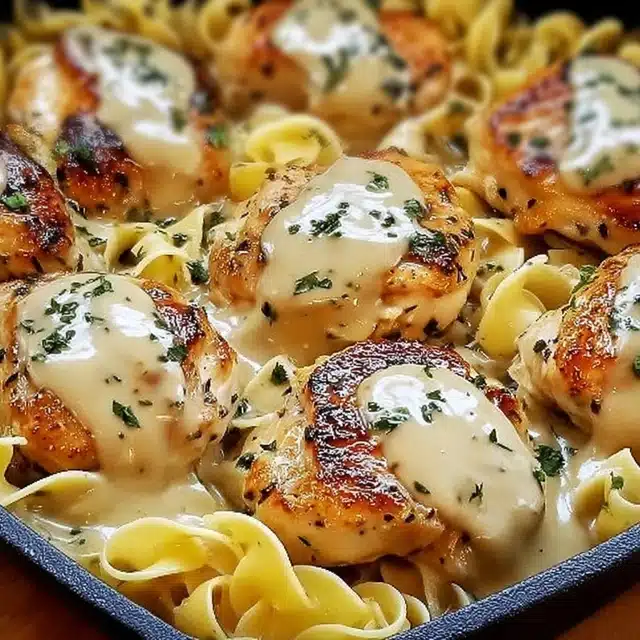
At its heart, this recipe is a celebration of fundamentals. Juicy, golden-brown chicken breasts are seared to perfection, then nestled in a fragrant garlic-infused chicken broth that doubles as a cooking liquid for tender egg noodles. A generous amount of real butter—some for searing, more for finishing—creates a silky, glossy sauce that coats every strand of noodle. Fresh parsley adds a bright, herbaceous finish. That is it. No cream, no wine, no complicated techniques. Just chicken, noodles, butter, garlic, broth, and parsley.
The beauty of this dish lies in its efficiency and elegance. Everything cooks in a single skillet, from the initial sear to the final simmer. The chicken is removed after browning, allowing you to build the sauce in the same pan with the browned bits (fond) that are packed with flavor. The noodles cook directly in the seasoned broth, absorbing all that savory goodness as they become tender. The butter is added at two stages: first for searing, then stirred in at the end for richness and shine.
This recipe is weeknight gold. It takes about 30 minutes from start to finish, uses minimal dishes, and delivers a meal that feels far more luxurious than its ingredient list suggests. It is also endlessly adaptable: add a handful of frozen peas or spinach for color and nutrition, sprinkle with Parmesan for extra savoriness, or swap the chicken for shrimp or thinly sliced steak.
In this article, you will find a comprehensive guide to making One-Pan Chicken with Buttered Noodles from scratch. We will cover ingredient selection, step-by-step preparation, expert tips for achieving perfectly cooked chicken and noodles, storage instructions, and detailed answers to frequently asked questions.
Ingredients
Before you begin, gather all of your ingredients. Because this dish moves quickly once cooking starts, having everything prepped and within reach is essential. Below is the complete list.
For the One-Pan Chicken with Buttered Noodles
| Ingredient | Quantity | Notes |
|---|---|---|
| Boneless, skinless chicken breasts | 4 (about 1.5 lbs total) | Even thickness for uniform cooking |
| Egg noodles | 8 oz | Wide or medium egg noodles |
| Real butter | 4 tablespoons | Divided use (1 tbsp + 3 tbsp) |
| Garlic | 4 cloves | Minced fresh |
| Low-sodium chicken broth | 2 cups | Essential for flavor; regular broth is too salty |
| Fresh parsley | ¼ cup | Chopped; flat-leaf or curly |
| Salt and pepper | To taste | Kosher salt and freshly ground pepper |
Optional Additions
| Ingredient | Notes |
|---|---|
| Frozen peas | ½ cup; add with the noodles |
| Fresh spinach | 2 cups; stir in at the end until wilted |
| Grated Parmesan cheese | For serving |
| Lemon zest | 1 teaspoon; adds brightness |
| Red pepper flakes | ¼ teaspoon; for heat |
Preparation Method
Step 1: Prep Your Ingredients
Do all of your chopping and measuring before you turn on the heat. This dish comes together quickly, so having everything ready is essential.
- Mince the 4 cloves of garlic.
- Chop the fresh parsley (about ¼ cup).
- Pat the chicken breasts completely dry with paper towels. This is crucial for achieving a golden-brown sear.
- Measure the chicken broth (2 cups).
- Have the egg noodles and butter ready.
Step 2: Sear the Chicken
Place a large skillet (12-inch recommended with a lid) over medium-high heat. Add 1 tablespoon of butter and allow it to melt completely, swirling to coat the bottom of the pan.
While the butter melts, season the chicken breasts generously on both sides with salt and pepper (about ½ teaspoon salt and ¼ teaspoon pepper total).
Once the butter is hot and bubbly (but not burning), carefully place the chicken breasts in the skillet in a single layer. Do not overcrowd—if necessary, cook in two batches.
Let the chicken cook undisturbed for 5 minutes. Do not move or flip the chicken during this time. This allows a deep golden-brown crust to develop.
Flip the chicken and cook for another 5 minutes on the second side. The chicken should be golden brown on both sides but not necessarily cooked through—it will finish cooking in the broth.
Transfer the seared chicken to a clean plate and set aside. Do not wipe out the skillet—those browned bits (fond) are liquid gold.
Step 3: Sauté the Garlic
Reduce the heat to medium. Add the minced garlic to the same skillet. Sauté for 1 minute, stirring constantly, until fragrant. Do not let the garlic brown or burn—burnt garlic becomes bitter and can ruin the dish.
If the skillet seems dry at this point, add a tiny splash of olive oil or an additional ½ tablespoon of butter.
Step 4: Add the Chicken Broth and Boil
Pour 2 cups of low-sodium chicken broth into the skillet. Use a wooden spoon or spatula to scrape up any browned bits from the bottom of the pan. This step, called deglazing, releases all that concentrated flavor into the liquid.
Increase the heat to high and bring the broth to a rolling boil.
Step 5: Add the Noodles and Simmer
Once the broth is boiling, stir in 8 oz of egg noodles. Return the seared chicken breasts to the skillet, nestling them into the noodles and liquid.
Reduce the heat to medium-low (a gentle simmer). Cover the skillet with a lid.
Let the noodles and chicken simmer for 8 to 10 minutes, stirring the noodles occasionally to prevent sticking. The noodles are ready when they are al dente (tender but still firm to the bite). The chicken should reach an internal temperature of 165°F (74°C).
If the liquid has been completely absorbed before the noodles are tender, add ¼ cup of water or additional chicken broth. If there is excess liquid at the end of cooking, remove the lid and simmer for 1–2 minutes to reduce.
Step 6: Finish with Butter and Parsley
Remove the skillet from the heat. Add the remaining 3 tablespoons of butter to the pan, stirring gently until the butter melts completely and incorporates into the sauce. The butter will create a glossy, silky finish that coats the noodles and chicken.
Sprinkle the chopped fresh parsley over the dish. Toss gently to distribute.
Step 7: Serve Immediately
Serve the chicken and buttered noodles hot, directly from the skillet or on individual plates. Spoon extra pan sauce over the chicken before serving.
For added flavor, garnish with additional fresh parsley, grated Parmesan cheese, or a crack of black pepper.
Expert Tips for Perfect One-Pan Chicken with Buttered Noodles
- Pat the chicken completely dry. Moisture is the enemy of browning. Dry chicken = golden-brown crust = flavorful chicken. Use paper towels to absorb every drop of surface moisture before seasoning.
- Do not crowd the pan. If your skillet is not large enough to hold all four chicken breasts in a single layer with space between them, sear in two batches. Overcrowding causes steaming instead of browning.
- Use low-sodium chicken broth. Regular broth contains significantly more salt. When reduced during cooking, it can make the dish overwhelmingly salty. Low-sodium gives you control.
- Do not overcook the noodles. Egg noodles cook quickly—usually 8 to 10 minutes. Check for doneness at 8 minutes. Overcooked noodles become mushy and unappealing.
- Use real butter. This recipe is built on the flavor of real butter. Margarine or butter substitutes will not provide the same richness, silkiness, or flavor.
- Add vegetables easily. For a more complete meal, stir in ½ cup of frozen peas or 2 cups of fresh spinach during the last 3 minutes of cooking. Peas will thaw and warm through; spinach will wilt beautifully.
- Make it with chicken thighs. Boneless, skinless chicken thighs are more forgiving than breasts and stay juicier. Follow the same cooking times (thighs are fully cooked at 165°F but remain tender up to 175°F).
Storage and Reheating
One-Pan Chicken with Buttered Noodles is delicious fresh, but leftovers are also excellent.
Refrigeration: Store leftovers in an airtight container in the refrigerator for up to 3 days. The noodles will absorb more liquid overnight, becoming softer.
Freezing: Freezing is not recommended. The texture of the noodles becomes mushy upon thawing, and the butter-based sauce may separate.
Reheating (stovetop): The best method. Place the desired portion in a skillet over medium-low heat. Add a splash of chicken broth or water to loosen the sauce. Stir gently for 4–5 minutes until heated through.
Reheating (microwave): Quick but softens the noodles further. Microwave individual portions on medium power for 60–90 seconds, stirring halfway through.
Conclusion
One-Pan Chicken with Buttered Noodles is a quiet masterpiece. It does not scream for attention with exotic spices or complicated techniques. Instead, it whispers of comfort, of home, of meals shared around a table on ordinary weeknights. The golden-seared chicken is juicy and tender. The egg noodles are silky and satisfying. The garlic-infused butter sauce is simple yet profoundly flavorful. And the fresh parsley adds a final note of brightness that elevates the entire dish.
This is the kind of recipe you will memorize. The kind you make when you are tired, when you are short on time, when you need something warm and satisfying without a lot of fuss. It is a reminder that great cooking does not have to be complicated—it just has to be done with care.
So preheat that skillet, mince that garlic, and get ready to fall in love with the beauty of simplicity. Your one-pan dinner awaits.
Frequently Asked Questions (FAQ)
1. Can I use chicken thighs instead of chicken breasts?
Absolutely. Boneless, skinless chicken thighs are more forgiving and stay juicier than breasts. Follow the same searing instructions (5 minutes per side). Thighs are fully cooked at 165°F but remain tender up to 175°F. The total cooking time in the broth remains 8–10 minutes.
2. Can I use a different type of noodle?
Yes. Egg noodles are traditional, but you can substitute:
- Wide egg noodles (same cooking time)
- Pappardelle (cooks in 8–10 minutes)
- Fettuccine (break in half; cook 10–12 minutes)
- Gluten-free egg noodles (adjust time per package)
Avoid very thin noodles like angel hair, which will become mushy.
3. Can I use water instead of chicken broth?
You can, but the dish will be significantly less flavorful. Chicken broth provides savory depth that water cannot replicate. If you only have water, add 1 teaspoon of chicken bouillon paste or a bouillon cube to the water.
4. Can I add vegetables to this dish?
Yes. Add any of the following during the last 3–4 minutes of simmering:
- Frozen peas (½ cup)
- Fresh spinach (2 cups; wilts in 1 minute)
- Sliced mushrooms (add with the garlic)
- Broccoli florets (small; add with the noodles)
- Zucchini (sliced; add with the noodles)
5. How do I know when the chicken is fully cooked?
The most reliable method is an instant-read thermometer. Insert it into the thickest part of the breast (avoiding bone if using bone-in). The chicken is safe to eat at 165°F (74°C). If you do not have a thermometer, cut into the thickest piece—the meat should be opaque white throughout with no pink.
6. My noodles turned out mushy. What went wrong?
Mushy noodles are usually caused by:
- Overcooking (simmered longer than 10 minutes)
- Too much liquid (noodles absorbed excessive liquid and became waterlogged)
- Stirring too aggressively (fragile noodles break down)
Next time, check for doneness at 8 minutes and remove from heat as soon as the noodles are al dente.
7. Can I add Parmesan cheese to this dish?
Yes. Grated Parmesan adds a wonderful salty, nutty depth. Sprinkle it over the finished dish just before serving, or stir ½ cup into the sauce along with the final butter.
8. Can I make this dairy-free?
Yes, with substitutions. Use vegan butter (4 tablespoons total) in place of dairy butter. The sauce will still be rich and glossy. Omit Parmesan or use a dairy-free alternative.
9. Can I use garlic powder instead of fresh garlic?
Fresh garlic is strongly recommended for this recipe. Garlic powder cannot replicate the pungent, aromatic quality of fresh. If you must substitute, use 1 teaspoon of garlic powder added with the chicken broth.
10. Can I double this recipe?
Yes, but you will need a very large skillet (14-inch or larger) or a Dutch oven. Double all ingredients. You may need to increase the simmering time by 2–3 minutes. Do not overcrowd the pan when searing the chicken—sear in batches.
11. What should I serve with this dish?
This dish is a complete meal on its own, but it pairs well with:
- A simple green salad with lemon vinaigrette
- Roasted asparagus or green beans
- Steamed broccoli with a squeeze of lemon
- Crusty bread (for sopping up the butter sauce)
12. Can I add lemon to this dish?
Absolutely. Lemon adds brightness that complements the rich butter sauce. Add 1 teaspoon of lemon zest with the parsley, or squeeze ½ lemon over the finished dish just before serving.
PrintOne-Pan Chicken with Buttered Noodles – Simple, Elegant, and Ready in 30 Minutes
A simple and comforting One-Pan Chicken with Buttered Noodles made with tender chicken breasts, egg noodles, garlic butter, and fresh parsley for an easy family dinner.
- Prep Time: 10 minutes
- Cook Time: 20 minutes
- Total Time: 30 minutes
- Yield: 4 servings
- Category: Main Dish
- Method: One-Pan
- Cuisine: American Comfort Food
Ingredients
- 4 boneless, skinless chicken breasts (1.5 lbs)
- 8 oz egg noodles
- 4 tbsp butter
- 4 cloves garlic, minced
- 2 cups low-sodium chicken broth
- 1/4 cup fresh parsley, chopped
- Salt and pepper to taste
Instructions
- Season and sear chicken in butter until golden brown, about 5 minutes per side.
- Add garlic and sauté until fragrant.
- Pour in chicken broth and bring to a boil.
- Add egg noodles and simmer until tender, about 8–10 minutes.
- Stir in remaining butter until melted and creamy.
- Finish with parsley, salt, and pepper before serving.
Notes
- Add spinach or peas for extra vegetables.
- Use rotisserie chicken to speed up cooking time.